
The Second Edition - New
Service operations,
engineered as one system.
The Framework sets out the full operating model for modern service operations: seven layers from infrastructure to agentic AI, the people who run it, and the maturity path from Establish to Evolve.
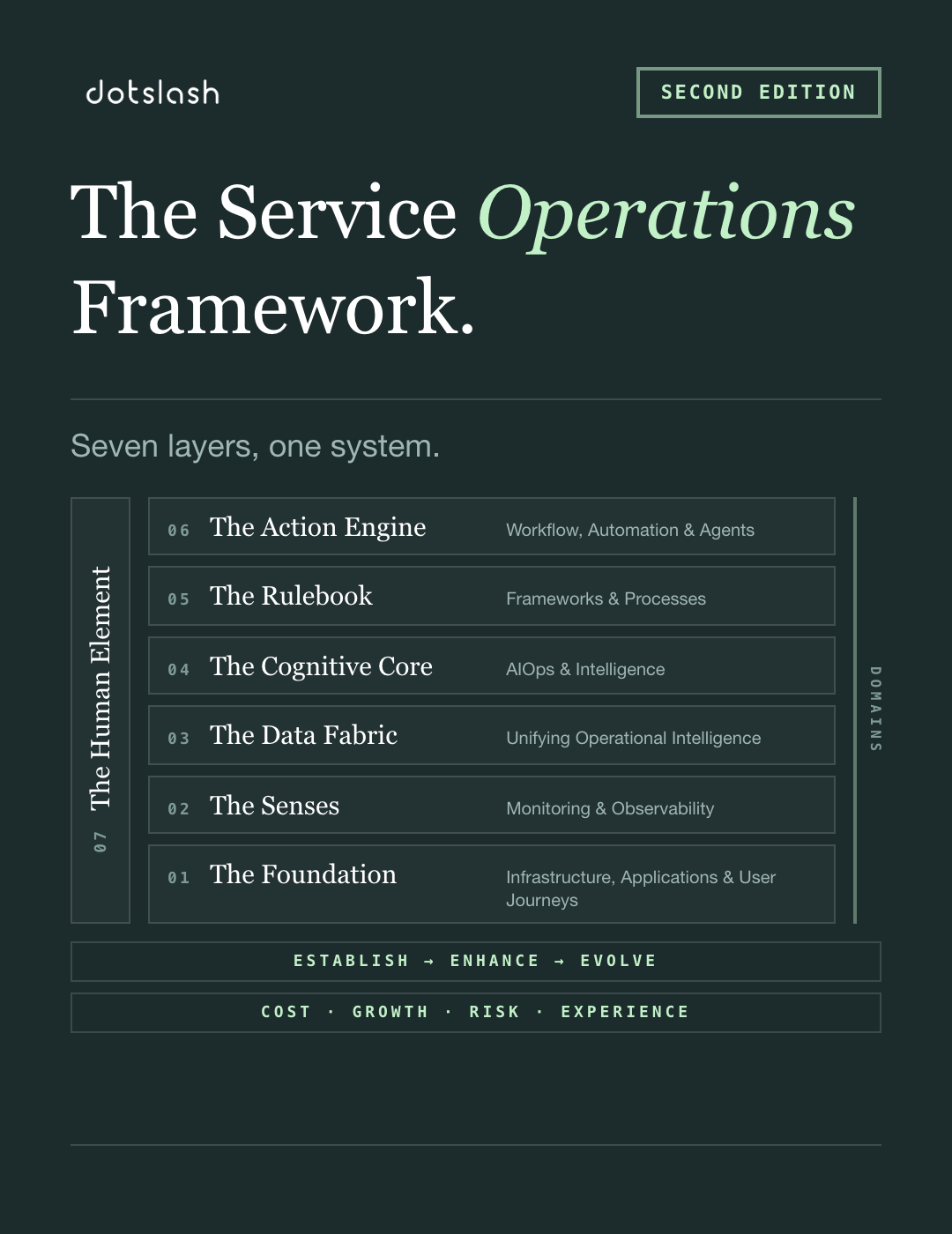
The Service Operations Framework, Second Edition
One model for how modern service operations fit together, from infrastructure to autonomous action, and the people who run it.
- Autonomous IT
- Automated Operations
- Workflow & Runbooks
- Automation
- Agents / Agentic AI
Where decisions become action. Workflows, automation and agents execute what the layers below have sensed and reasoned, from routine runbooks to autonomous operations.
- Processes | Policies | Work Instructions
- ITIL | Regulatory | Operational Frameworks
How the organisation has decided operations should run. Processes, policies and the frameworks they answer to, encoded where both people and automation can follow them.
- AIOps & Observability Platform(s)
The reasoning layer. Correlation, probable cause and impact assessment happen here: one cognitive core across the operational estate, fed by the data fabric below and driving the action engine above.
- Data Model(s)
- Data Layer (Events, Alerts, CIs, KBIs, KBAs, Metrics, Logs, Traces, Incidents, Problems, Changes, Postmortems, Social Feeds, 3rd Party, Source Control, CI/CD Pipelines, Pull Requests, Deploys, Release Events)
Operational data made usable. Events, telemetry and records of work unified under one model, so every layer above reasons from the same version of the truth.
- Monitoring & Alerting
- Observability
What the estate can see and how it tells you. Coverage, alert quality and telemetry, treated as one discipline rather than two camps.
- Applications & User Journey Layer
- Infrastructure Layer
Everything above depends on what runs here. Applications, infrastructure and the user journeys they serve: the estate the rest of the framework observes, reasons about and acts upon.
- Cost
- ·
- Growth
- ·
- Risk
- ·
- Experience
"Service Management didn't go mainstream until ITIL gave people a framework to adopt. Service Operations is in exactly that place today."
PHILIP TAPHOUSE · CO-FOUNDER & CEO, DOTSLASH
maturity ladder
Establish. Enhance. Evolve.
Stage 1
Establish
Foundations in place: monitoring coverage, clear ownership, and a single source of operational truth.
Stage 2
Enhance
Noise collapses into signal: correlation, automation of the repeatable, and measured service views.
Stage 3
Evolve
The system runs itself where it should: agentic operations, with people on the exceptions and the decisions.
Value Lens
Where the value lands: CGRX.
Every layer and every engagement is read against four outcomes. It is how we scope work, and how we report it.
Talk to us about the Framework.
Process your teams ignore is worse than no process at all. We build service management your teams actually use.