
Services · Target Operating Model
The Other Half Of Transformation.
Operating Models, Engineered.
We design Service Operations target operating models: the structure, governance, funding and roles that decide whether your platform transformation pays.
This is for the leader whose platform got transformed while the organisation around it stayed put. New AIOps, new automation, an integrated toolchain, and the same structure, queues and funding arguments wrapped around it.
We redesign the function to match the platform, in weeks and with the people who will run it, and we hand over a blueprint that is ready to implement the Monday after.
Why It Matters
New Platform, Old Organisation.
The transformation was scoped the way transformations always are, around the technology rather than the organisation that has to run it. The organisation was left to adapt, and organisations do not adapt on their own. They persist. Demand keeps arriving from everywhere and landing on whoever answers. Nothing carries a cost, so everything is urgent and nothing is funded. Ownership blurs across teams, tiers and partners until nobody can say who decides, and the people closest to the work spend their days on tasks the platform could already do.
The awkward fact is that the old structure was honest once. Tiers existed because triage was human work, queues existed because handoffs were how context moved, and big teams existed because toil was manual.
The technology moved. The structure running it did not. That gap is where the business case falls apart.
The platform has since absorbed those constraints, correlating signal before a bridge call forms, resolving the routine automatically and moving context through an integrated toolchain instead of between screens. The structure never
And when the organisation is finally addressed, it is usually addressed as arithmetic: a benchmark, a percentage, a reshuffle on a slide. Structure changes; work does not. A leaner structure delivers nothing on its own. The function that comes out of a proper redesign is usually smaller and always more senior, with fixed cost converted into flexible capacity. That is a consequence of capability, not a target we start from.
What We Design
More Than An Org Chart.
Five design surfaces, one coherent model. The org chart is the last page, not the first.
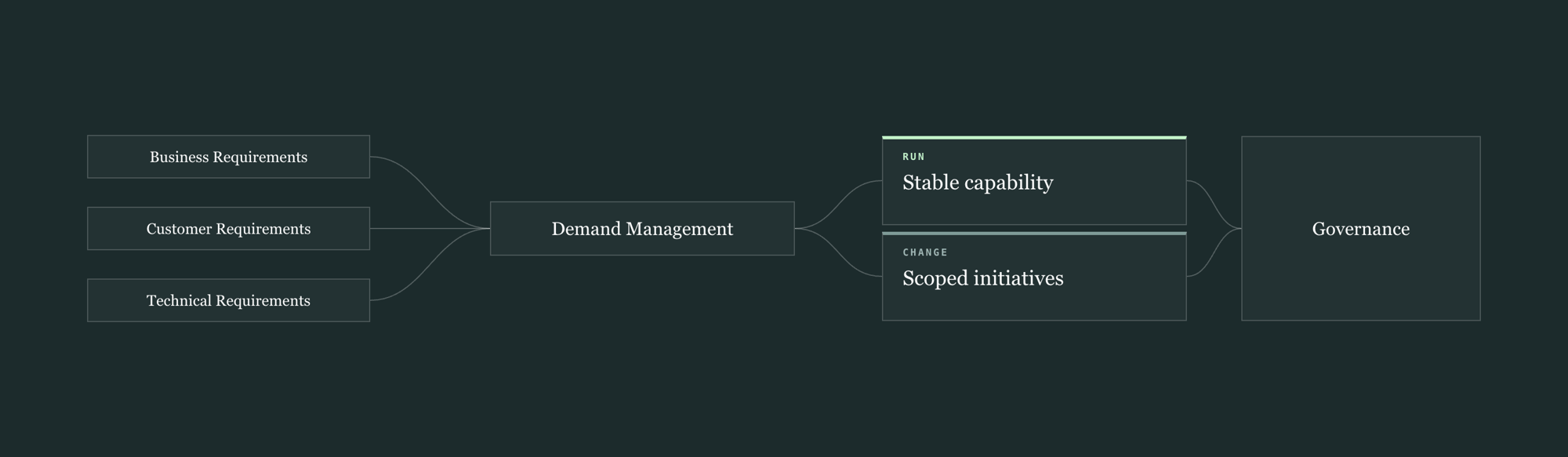
- The operating modelRun separated from change: a stable capability whose job is reliability, and scoped, funded initiatives whose job is outcomes. The design covers how work flows between the two, who owns what, and where partners fit.
- Demand and budgetOne front door for everything, where demand is costed, prioritised, and then funded or declined, with full financial accountability for what lands on the platform.
- GovernanceA design authority that actually decides, guardrails that hold under deadline pressure, non-negotiables that stay non-negotiable, and a real exception path instead of a quiet workaround.
- The org chart and rolesA lean core and a flexible edge, with every role defined by purpose, responsibilities, decision rights and competencies and mapped against the organisation you have today. Ready for workforce planning, not just the wall of the design workshop.
- TransitionThe technical strategy to get there, whether that is remediation or re-platforming, laid out as a phased roadmap with sequencing, dependencies and ownership.
What You Get
Built To Be Implemented.
#DeliverableDescription
- Target operating model blueprintThe full design of the operating model: structure, the separation of run and change, the interaction model between internal teams and partners, and the principles the platform operates by.
- Role catalogueEvery role defined by purpose, responsibilities, decision rights and competencies, mapped against your current organisation and ready for workforce and HR planning.
- Demand management frameworkThe front door end to end, from intake and triage through financial assessment and prioritisation to the decision pathways, including no.
- Platform governance charterForums, decision authority and escalation, together with the architectural guardrails, the non-negotiables and how exceptions are handled.
- Transformation roadmapThe phased transition from the model on paper to the model in operation, with sequencing, dependencies, ownership and success measures.
Every deliverable arrives to the same standard: explicit enough for your board to approve, specific enough for your teams to execute. There is no further design work between the blueprint and the build, and the handover includes the decision log and the working, so the reasoning survives the engagement.
Case Study
How dotslash Transformed The Service Operations TOM Model Of A Global Enterprise Saving Over £1.8m While Delivering Increased Efficiency.
The reference engagement
A full Service Operations target operating model for a global engineering group, spanning structure, roles, governance, demand and the technical transition.
- 12weeks, validation to implementation-ready blueprint
- 7re-engineered processes
- 13job roles defined
- Introduction of the Demand Process & Policy covering all Service Operations platforms
- Detailed implementation plan
- Union meeting preparation & supporting artefacts
- Organisation chart, governance model & supporting materials
- Redesigned commercial model (partners & vendors) to support the FWoW
- Board playback and approval
Further Reading
Explore Our Expertise.
Monitoring & Alerting
Know when something changes.
The signal layer: event management done properly. It watches the health, state and performance of everything you run, and raises the alarm when something deviates.
Observability
Understanding why, not just what.
Monitoring tells you something’s wrong. Observability tells you why, across distributed, fast-moving systems where the cause is rarely where the symptom shows up.
AIOps
Event Intelligence, at scale
When alert volumes grow overwhelming, AIOps cuts through the noise. By applying correlation and prediction, a torrent of events becomes the focused shortlist that demands attention.
IT Service Management
Turning signal into accountable action.
This is where insight becomes managed work. Incident, Problem and Change: the system of record and the process that gets things owned, resolved, learned from, and communicated.
Structure Is Permission.
A leaner structure delivers nothing on its own. It is permission to work differently. The operating model is where that permission gets written.