
IT Service Operations · AIOps
The Brain Of IT Operations.
AIOps is the intelligence that turns a flood of events, logs, metrics and alerts into clear insight and an actionable response, faster than it would be possible for any operations team to do at scale.
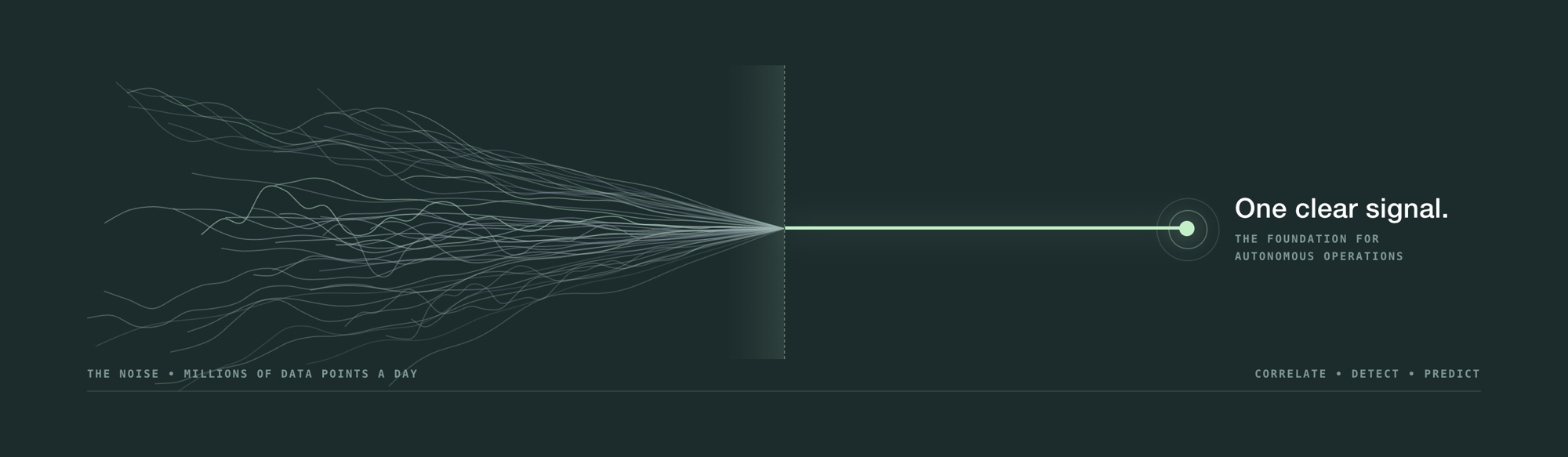
Every live service throws off more data than a person can process. Millions of data points a day, arriving all at once, burying the critical signal in noise.
AIOps is what turns that into a decision. It is the decide stage of the operations loop: it correlates, finds the pattern, predicts what breaks next, and increasingly acts on it. Detect and understand tell you what is happening. AIOps works out what to do about it.
Fact, not fiction
The Reality Of AIOps.
It primarily does three things. It correlates, grouping a flood of related events, logs, metrics, and alerts into a single actionable root-cause incident, with every underlying part still visible. It detects anomalies, reading the shift in a pattern so you handle a warning instead of an outage. And it predicts, reading the early signal that a service is heading for trouble while there is still time to act.
We build AIOps as a capability at the centre of your IT Operations, not a product bolted onto the side of it.
At its core, AIOps is simply machine learning pointed at operations data, designed to do what traditional IT Operations teams cannot sustainably do at scale.
This intelligence is a capability to be built, not a product that drops in on a Friday and runs your operation by Monday.
It is only ever as good as two things: the data you feed it, and the operational discipline you build around it.
Feed It Right
Building On Clean Signals.
Standardisation is the prerequisite to automation. Different tools will always generate alerts in their own formats; an APM warning looks nothing like a network alert, even when they report the same failure. The key is how they are understood. By mapping disparate data to standardised attributes, correlation becomes highly accurate, making automated IT operations bulletproof.
We ground this in practical reality. Whether you are tuning your event management platforms to effectively group alerts, configuring your observability tools for precise anomaly detection, or ensuring the ‘Impacted CI’ attributes and relationships in your CMDB are consistently populated for accurate routing, the principle remains the same. Clean, standardised, owned data is not a nice-to-have you get to before AIOps; it is the foundation of trust.
Get the data right, and the intelligence starts to deliver on its promise.
AIOps is only ever as good as the data underneath it. A machine learning model does not create the signal; it works with what arrives.
- DetectMonitoring & Alerting →
- UnderstandObservability →
- DecideAIOps
- ActIT Service Management →Learn
What Good Looks Like.
Built on clean data and run with discipline, AIOps fundamentally changes the economics of operations. Less noise, faster decisions, and fewer incidents requiring manual intervention.
In practice, a well-architected AIOps platform delivers on four fronts:
-
01
It groups without crushing.
A thousand related alarms become a handful of real incidents, but nothing is thrown away to get there. Take the four events behind one outage: a server, a database, the application, the network. Each stays intact as its own record, grouped under a single parent. The teams who own each piece still see their piece. The platform determines the root cause and escalates a major incident only if it warrants it. 95% fewer alarms to triage, and not one fact lost.
-
02
It catches things early.
Anomaly detection reads the shift in a pattern before any threshold trips, so you are handling a warning instead of an outage.
-
03
It compresses time.
When a single minute of a major incident can cost tens of thousands of pounds, the gap between a signal arriving and a decision being made is money. Auto-triage and enrichment close that gap. The first fifteen minutes stop being manual.
-
04
It enables autonomous action.
Precise signals allow low-risk fixes to run without a human in the loop at all. A service that restarts itself. Capacity that scales before it is exhausted. The incident that never becomes an incident because the system handled it while everyone slept.
“Initially, our incident count went up. For the first time, it was telling us the truth.”
Operations manager · Enterprise financial services
Short term, it might, thats totally normal. Those incidents are real; they were always happening. A count that rises because you stopped suppressing underlying issues is a step forward in visibility. Volume was never the true score. The score is how many of those incidents needed action, and how fast you cleared them.
Navigating The Maturity Curve.
The journey to autonomous operations involves predictable maturity hurdles. When AIOps is layered over inconsistent data without strategic oversight, it can inadvertently hinder the operation.
We help clients avoid these common traps.
-
01
Beyond suppression.
The most common early hurdle is pointing the system at a wall of noise and simply suppressing it. Silencing fifty thousand events a month treats the symptom rather than curing the disease, and you are still paying to ingest, process, and store that data. AIOps should be a diagnostic brain, not just an expensive barrier.
-
02
Earning automation.
Trusting automation blindly before signals are clean can amplify incorrect routing. Automation must do the right thing at scale, which means verifying the data before taking the human off the loop.
-
03
Maintaining trust.
A platform that misidentifies root causes too often trains engineers to ignore it. Once the team stops trusting the output, the most sophisticated correlation in the world becomes dead weight.
-
04
Preserving context.
Over-aggressive compression can throw away vital details. If an engineer opens an incident and cannot see the one log line that actually mattered because it was clustered out as ‘noise’, MTTR creeps back up.
Every one of these hurdles comes from the same root: assuming precision where it hasn’t yet been earned.
Earned, Not Assumed
Earning The Automation.
Our approach is the opposite of the magic-box pitch.
We build AIOps capabilities that earn their trust. Clean data first, precision before automation, and a human in the loop until the system has proved itself.
01
We fix the foundations first.
We ensure your data is standardised, owned, and cost-aware, so the system works with clean signal. If the data is not ready, we help you get it there before activating the automation.
02
We measure the right thing.
Not how many events you suppressed, but how many of the events you generate actually need action. That actionability score dictates the true health of your operations.
03
We automate in stages.
A human in the loop first, then a human on the loop, and finally hands-off only where the signal has proved precise enough to trust. Automation follows confidence; it never runs ahead of it.
04
We keep tuning.
AIOps is not a project with a fixed end date. It is a continuous capability requiring a small standing investment every sprint, ensuring the models sharpen over time instead of drifting back into noise.
The Intelligence Behind Autonomy.
Self-healing services. Predictive capacity. Operations that run themselves. None of it is possible without AIOps, and none of it is sustainable on a foundation of noise.