
Solutions · IT Service Operations
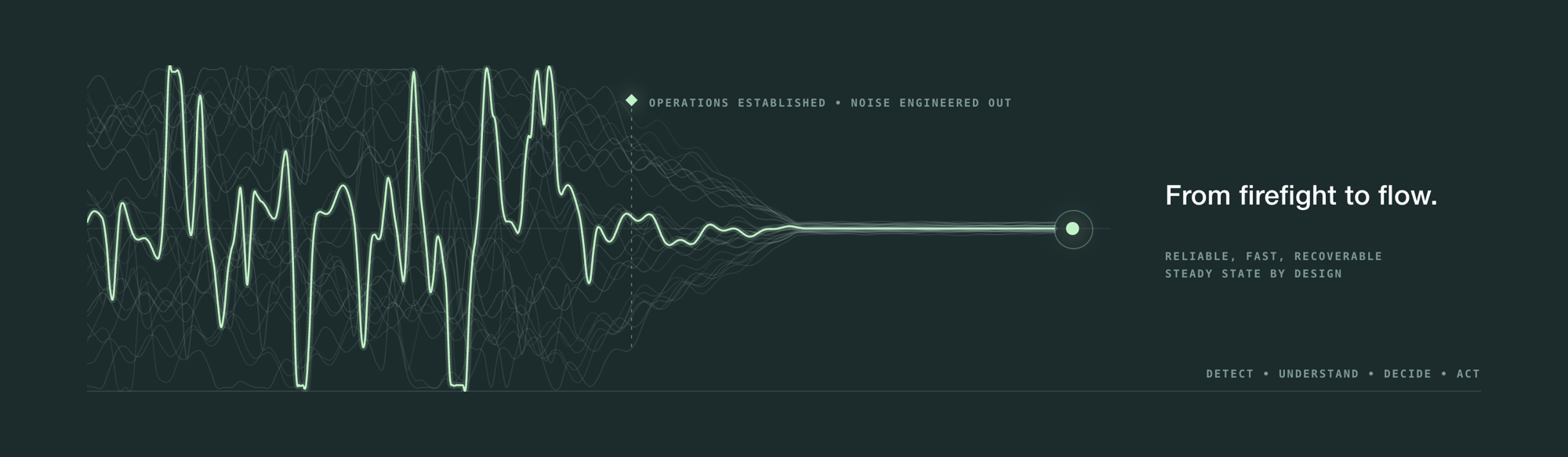
From Firefighting To Flow.
IT Service Operations is how you keep live services reliable, fast and recoverable. So the business can stop wondering whether the technology will hold up, and get on with the work.
What is Service Operations?
Keep Services Running.
Service Operations is the end-to-end discipline of running live IT services, one continuous flow, from a signal somewhere in the monitoring tools, through to a resolved incident and an outcome you actually learn from. Detect, understand, decide, act, learn & run as a single loop, not as disconnected steps.
Done Well
Done well, nobody notices it. Services are available, performance holds, and an issue is resolved before users ever feel it. That invisibility is the outcome.
Done Badly
Done badly, everybody notices. Alerts no one owns. Outages found by customers before they're found by you. The same incident firefought for the third time this quarter because nothing learned from the first two.
The difference isn't a missing tool. It's whether the whole thing runs as one operation, or four separate disciplines that never quite meet.
The Point of View
Four Towers, One Operation.
Most organisations don’t run Service Operations. They run four things that happen to sit near each other: monitoring in one team, observability in another, AIOps as a platform someone bought, service management as the ticket queue down the hall. Separate tools. Separate teams. Separate budgets.
Alone, not one of them is the answer. Monitoring is just noise with no one to catch it. ITSM is paperwork written after the damage is done. Observability is a brilliant answer to a question nobody asked. AIOps just automates the chaos faster.
Treat them as four different things and the seams between them belong to no one, which is exactly where the damage lives. The noise, the manual triage, the incidents that keep coming back: almost all of it happens in the handoffs, not the towers. So we define Service Operations as a single discipline, deliberately, not as a label, but as a forcing function. Make it one discipline, and the seam stops being a gap to fall through. The gap is the work.
Run as one operation, the four towers become stages, capabilities inside Service Operations, not adjacent to it:
01
Monitoring & Alerting catches the moment something changes.
02
Observability explains why.
03
AIOps cuts the noise into a signal you can act on.
04
IT Service Management turns that signal into owned, accountable action.
The integration that ties those four together isn't a fifth tool you buy. It's what exists once they run as one, the integrated tool chain.
Detect, understand, decide, act, learn: one flow, one owner, one outcome. Pull a stage out and it breaks, and you're back to firefighting, just with more dashboards.
STAGE 01
Detect
Monitoring & Alerting
STAGE 02
Understand
Observability
STAGE 03
Decide
AIOps
STAGE 04
Act
IT Service Management
←↑
LEARN
The Integrated Tool Chain
So when someone sells you "the AIOps platform that fixes everything," be sceptical. The platform is one stage. The value is the whole operation. Get the operation right as a system, and the tools finally start earning their licence fees.
Four capabilities, not four tools on a shopping list, plus the integration that emerges when you run them as one. Each is a place we can help, from advisory and strategy through to design and hands-on implementation. On their own, none of them is Service Operations. Together, they are.
Component 01
Monitoring & Alerting
Know when something changes.
The signal layer, event management done properly. It watches the health, state and performance of everything you run, and raises the alarm when something deviates, ideally before a user ever feels it. The discipline isn't collecting everything; it's collecting the right things, so the alert that fires is the one that matters.
Monitoring & Alerting →Component 03
AIOps
Event Intelligence, at scale.
When alert volumes grow overwhelming, AIOps cuts through the noise. By applying correlation and prediction, a torrent of events becomes the focused shortlist that demands attention.
AIOps →Component 02
Observability
Understanding why, not just what.
Monitoring tells you something's wrong. Observability tells you why, across distributed, fast-moving systems where the cause is rarely where the symptom shows up. It's the difference between "checkout is slow" and "checkout is slow because this dependency is timing out under this specific load."
Observability →Component 04
IT Service Management
Turning signal into accountable action.
This is where insight becomes managed work. Incident, Problem and Change — the system of record and the process that gets things owned, resolved, learned from, and communicated. Without it, even perfect detection goes nowhere. With it, every signal has a home and an owner.
IT Service Management →Emergent
Integrated Toolchain
What the other four become.
Not a fifth capability bolted on, the state the other four reach when they're run as one. Most operations don't fail for lack of tools; they fail in the gaps between them, where a signal in one system never reaches the action in another. An integrated tool chain closes those gaps, so data and action flow end to end and the operation behaves as one system rather than four silos passing blame. It almost never happens by accident, wiring the towers into a single flow is deliberate, painstaking work, and some of the most valuable we do.
Wherever You Are.
Almost no one starts from zero, and almost no one is finished. You've likely got strong monitoring and weak observability, or a mature ITSM platform sitting on a fragmented tool chain. It's rarely about buying the missing piece, it's about making the pieces you already own work as one.
That's the work we do. Across the whole operation, we offer advisory to set the strategy, design to shape the target state, and hands-on implementation to build it, picking tools that fit your operation rather than bending your operation to fit a tool.